How to Perfectly Balance Your Pool Water
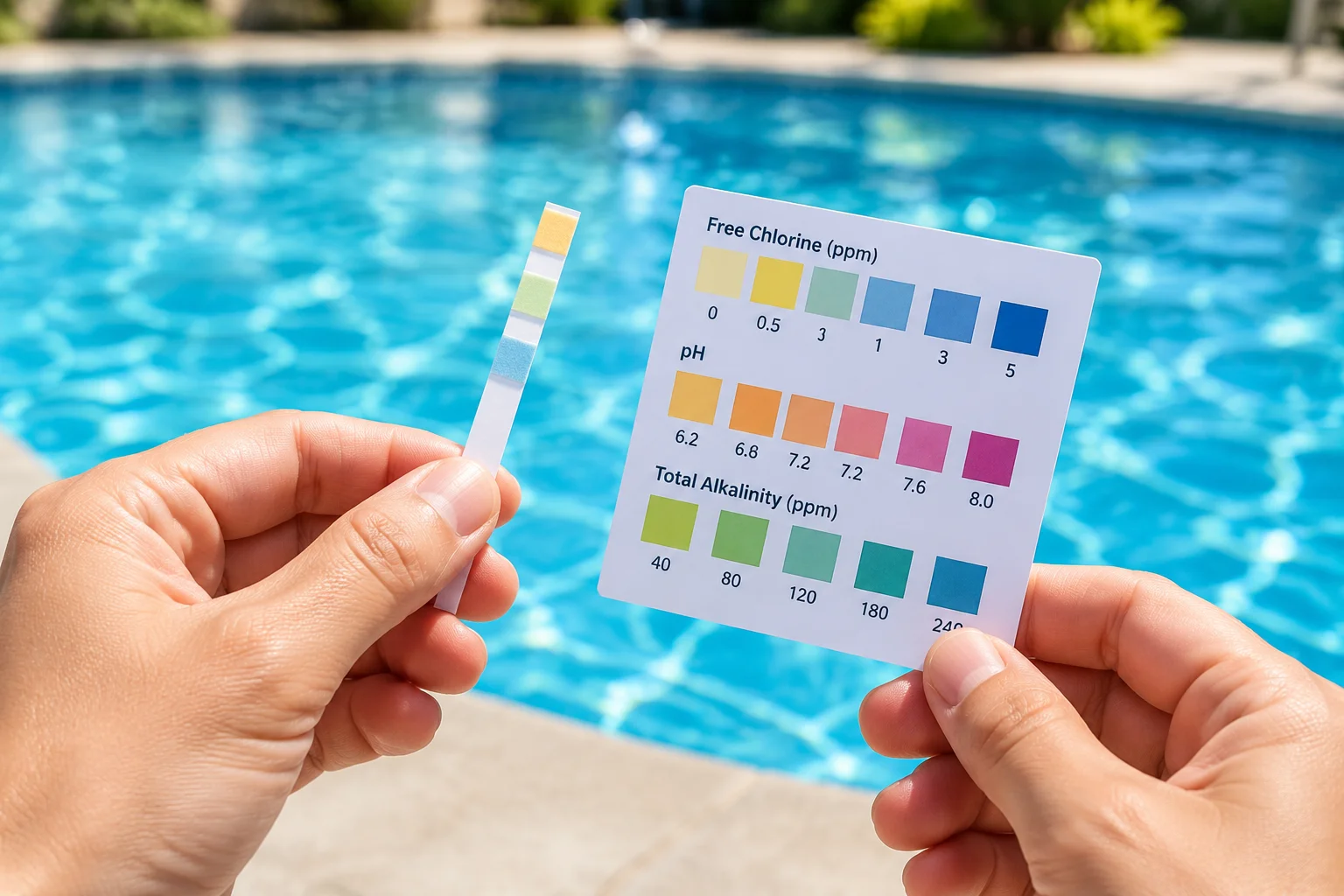
Achieving pristine swimming water requires balancing three interdependent chemical pillars: total alkalinity, pH level, and free available chlorine. Whenever alkalinity fluctuates outside the 80 to 120 ppm baseline, the water loses its buffering capacity, causing rapid pH spikes that burn swimmers' eyes or precipitate mineral scale across heat exchangers. Following a disciplined, sequential testing regime ensures sanitizers destroy pathogens efficiently while keeping your pool finish and mechanical seals protected against aggressive water corrosion.
Equipment Longevity
Balanced water prevents acid erosion of copper heat exchangers, heater elements, and pump mechanical seals.
Optimal Sanitizer Power
Keeping pH strictly between 7.4 and 7.6 maximizes chlorine disinfection efficiency without irritating swimmer eyes.
Predictable Chemistry
Dialing in total alkalinity first establishes a resilient buffer against sudden swings caused by heavy rain or bather load.
01The Balancing Order: Alkalinity and pH First
Begin every balancing session by measuring total alkalinity before adjusting any other chemical factor. Alkalinity acts as a chemical cushion that absorbs acids and bases without dramatically shifting overall pH. When alkalinity drops below 80 ppm, pH bounces erratically with the slightest addition of sanitizers or rain, creating corrosive conditions that dissolve plaster and etch metal components. Conversely, alkalinity exceeding 140 ppm locks pH into stubborn elevated values that resist standard acid treatments.
Once alkalinity stabilizes between 80 and 120 ppm, adjust the water pH into the target window of 7.4 to 7.6. At this specific range, free chlorine converts reliably into hypochlorous acid, its most potent germ-killing state. Elevated pH above 7.8 renders chlorine sluggish and ineffective, allowing green or mustard algae spores to establish bloom colonies despite adequate chemical dosing.
02Sanitizer Optimization & Stabilization
Active sanitation requires maintaining free available chlorine between 2.0 and 4.0 ppm continuously throughout the swim season. Direct sunlight rapidly degrades unstabilized outdoor pool chlorine through ultraviolet photolysis, reducing chemical longevity significantly. Incorporating cyanuric acid creates a protective molecular shield that preserves sanitizer active life.
- Maintain cyanuric acid levels strictly between 30 and 50 ppm to avoid chlorine lock situations.
- Dose non-chlorine oxidizer or shock treatments after peak swimming sessions or wind storms.
- Keep combined chlorine below 0.5 ppm to eliminate chloramine odors and stinging eye sensations.
Measure calcium hardness to protect your physical pool shell and plumbing pipes. Maintaining calcium hardness between 200 and 400 ppm prevents aggressive water from leeching minerals directly out of plaster and tile grout. In vinyl-lined and fiberglass vessels, adequate calcium maintains water weight and prevents liner wrinkling and premature gel-coat fading.
03Target Chemistry Baselines Reference Chart
Use this reference table to evaluate weekly liquid reagent or digital test results before dosing corrective chemicals into the skimmer or deep end:
| Parameter / Metric | Target Baseline | Recommended Action |
|---|---|---|
| Total Alkalinity (TA) | 80 - 120 ppm | Add sodium bicarbonate to increase; use muriatic acid aeration to lower. |
| Acidity / Basicity (pH) | 7.4 - 7.6 | Add sodium carbonate (soda ash) to raise; add sodium bisulfate to lower. |
| Free Available Chlorine | 2.0 - 4.0 ppm | Add slow-dissolving trichlor tablets or shock with calcium hypochlorite. |
| Calcium Hardness (CH) | 200 - 400 ppm | Add calcium chloride to raise; dilute with fresh supply water to reduce. |
04Routine Weekly Testing & Correction Routine
Establish a consistent testing schedule twice each week, drawing water samples at elbow depth away from return jets and skimmer mouths. Water pulled right next to surface returns often exhibits localized chemical spikes that misrepresent whole-pool parameters. Always verify baseline readings with calibrated multi-reagent drop kits or professional photometers rather than expired test strips.
Always dissolve dry chemicals in a bucket of pool water prior to introducing them along the perimeter. Pour solutions gradually while running the circulation pump to facilitate rapid dispersion across the entire basin. Wait at least four hours between separate chemical additions so individual compounds blend completely without undesirable reactions.
Keep Your Water Crystal Clear All Season
Browse our full selection of certified test kits, pH adjusters, non-chlorine shocks, and premium maintenance gear.